October 14, 2026
Jud Smith
TL;DR:
A very strong El Niño is forecast for the 2026-27 Utah winter, bringing warmer temperatures and more freeze-thaw cycles, not guaranteed snow. Clear your gutters, check downspout drainage, and address ice-prone areas before the first storm.
Your gutters handled last winter, so you have not thought about them since. A mild winter says nothing about a hard one, and this year’s forecast isn’t mild.
NOAA’s Climate Prediction Center has an El Niño Advisory in effect, with a greater than 90% chance of a very strong event this fall and winter. There is a 75% chance it becomes the strongest since 1950.
An El Niño Utah winter brings more freeze-thaw than snow load. Good gutter installation and a clear system matter more in a winter that melts and refreezes than in one that simply piles up, and trouble starts with standing water in gutters.
In this post, you will learn:
- What a very strong El Niño means for Utah weather this winter
- How freeze-thaw cycles and ice damage a gutter system
- Whether your gutters and downspouts have the capacity
- Where water goes once it leaves the downspout
- The checks worth doing before the first storm
Key Takeaways: A very strong El Niño is forecast for this winter. Clearing your gutters, checking downspout drainage, and fixing ice-prone sections now costs far less than repairing water damage in the spring.
What a Super El Niño Means for Utah This Winter
El Niño is a warming of the central and eastern tropical Pacific Ocean that shifts storm tracks across North America. In a strong year, the southern tier turns wetter, and the northern tier often turns drier.
Utah sits on the line between them. That is why El Niño winters here range from heavy snowfall to unremarkable, and why the strongest El Niño patterns do not produce the same result every time.
Warmer, Not Necessarily Snowier
The temperature signal is clearer than the precipitation one. NOAA’s seasonal outlook places Utah in the area favored for above-normal temperatures from December through February, while northern Utah sits near a zone leaning drier and southern Utah leans wetter.
Warmer does not mean easier on a house. Storms that would have fallen as snow arrive as cold rain, and snow that does fall melts during the day and refreezes at night.
Why That Matters More Than Snow Load
A heavy snow winter is hard on a roof. A warm, wet winter is hard on a gutter system, because water keeps moving when it should be frozen and keeps freezing when it should be draining.
That cycle runs dozens of times between November and March in a typical Utah winter. In an El Niño Utah winter, it runs more.
Why It Matters: Nobody can promise Utah a snowy winter or a mild one. What you can control is whether your gutters handle the wet, freezing, thawing version of that forecast.

How Ice Dams Form and What They Do to Gutters
An ice dam starts in the attic, not the gutter. Warm air that escapes through gaps in the ceiling heats the underside of the roof deck, melting snow from below even when the air outside stays cold.
That meltwater runs to the roof edge, hits cold air over the eave with no heat beneath it, and freezes. Repeat that for a few days, and you have a ridge of ice that traps everything behind it.
What the Ice Does
The dam itself is not the problem. Water backing up behind it is, because it has nowhere to drain and starts working under shingles and into the fascia.
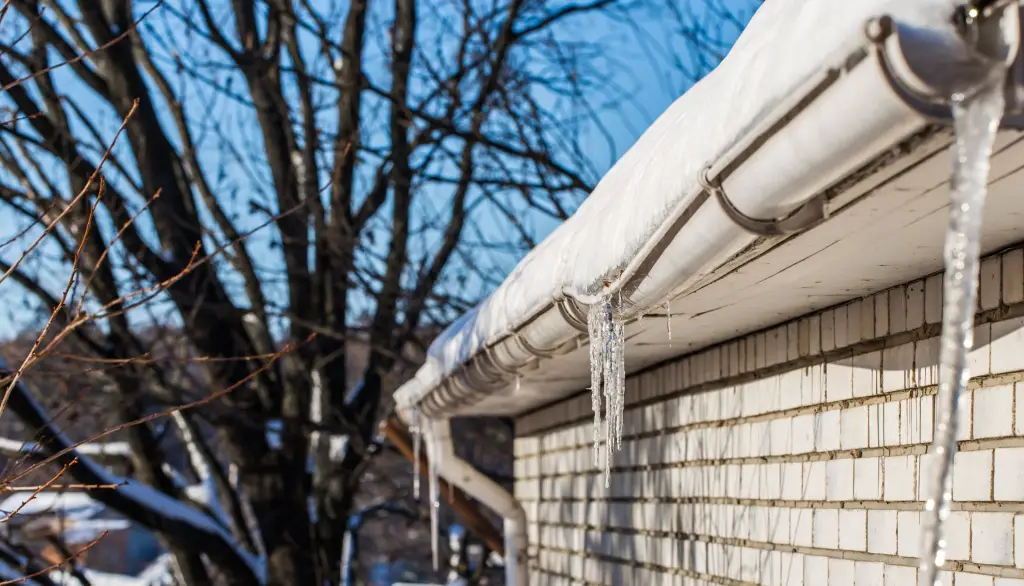
Gutters take the weight. A gutter full of ice can hold hundreds of pounds, pulling fasteners loose, bending the trough, and separating sections at the seams.
Fixing the Cause and the Symptom
Insulation and air sealing address the cause. Stopping heat loss into the attic keeps the roof deck cold enough that snow does not melt where it shouldn’t.
Heat tape addresses the symptom. Running cable along the roof edge and into the gutter and downspout keeps a drainage channel open through freezing temperatures, which is why ice melt systems exist for houses that dam up every year.
How It Works: Warm air escapes into the attic, melts snow on the roof, and the water refreezes at the cold eave. The ice builds, water backs up behind it, and the gutter carries weight it was never designed to hold.
Do Your Rain Gutters Have Enough Capacity?
Capacity is the question nobody asks until water is spilling over the edge. A 5-inch gutter handles most Utah homes, and a 6-inch handles a bigger roof or a steeper pitch that sheds water faster.
Older homes are where this surfaces. Gutters sized decades ago for a smaller roof, or replaced with whatever was cheapest, often cannot move what a rain-on-snow event delivers.
Downspouts Decide Everything
The trough collects. The downspouts move it, and that is where most systems fall short.
One downspout per 30 to 40 feet of gutter is the working guideline. Fewer than that and water backs up at the far end of the run, where it sits, freezes, and finds the seams.
What Clogged Gutters Do in Winter
A clogged gutter in July overflows. A clogged gutter in January becomes a block of ice that cannot drain at all.
Debris holds water in place long enough to freeze. That ice expands against the seams and fasteners, turning a season of neglect into leaks and a system that no longer functions in spring.
Signs To Watch For: Water overflowing at one end of a run, gutters that sag in the middle, icicles forming along a specific section, or a downspout that stays dry while others drain.

Where Standing Water Turns Into Water Damage
A gutter that holds water isn’t draining. Standing water adds weight, accelerates corrosion at the seams, and freezes into a solid mass that nothing can move through.
The damage does not stay at the roofline. Overflowing water runs down the wall, soaks the fascia, and collects at the base of the house.
What Happens at the Foundation
Downspouts that dump at the foundation are the most common problem we see. Water pools against the wall, works into cracks, and in a freeze-thaw winter it expands in those cracks.
What that leads to:
- Basement seepage through cracks that widen with each freeze cycle
- Potential flooding in low spots where runoff collects
- Moisture in the crawlspace that lingers through the season
- Shifting soil around the footing as saturated ground freezes and expands
Wood Rot and the Slow Version
Not all of it is dramatic. Wood rot in the fascia and soffit develops over seasons, quietly, while the gutter still looks fine from the ground.
Extensions and splash blocks direct water away and cost almost nothing. Protecting the property from this slow damage mostly depends on where the downspout ends, not what the gutter is made of.
Next Step: During the next rain, walk out and watch where your downspouts discharge. If water is pooling within six feet of the foundation, an extension is the cheapest repair you will make this year.
Pre-Winter Maintenance Requirements for Utah Gutters
Preparation is an afternoon, not a project. Work through this before the first hard freeze, and the season takes care of itself.
| What to check | When | Why it matters |
| Clear debris | Late October, after leaves drop | Twigs, leaves, and dirt hold water that freezes solid |
| Flush downspouts | Same visit | A blocked downspout backs the whole run up |
| Check the slope | Same visit | Standing water means the pitch is off |
| Inspect hangers and seals | Before first freeze | Loose fasteners fail under ice weight |
| Extend discharge | Before first freeze | Runoff pooling at the foundation causes expensive damage |
| Trim overhanging branches | Fall | Fewer twigs in the gutter, less weight on the roof |
Regular upkeep matters more than any single repair. A system cleared in October handles an El Niño Utah winter, and one left full does not.
What to Look For While You Are Up There
Inspect the seams and the fasteners, not just the channel. Gaps at the joints, dried and cracked caulk, and hangers that no longer sit securely are signs the system will not hold under ice.
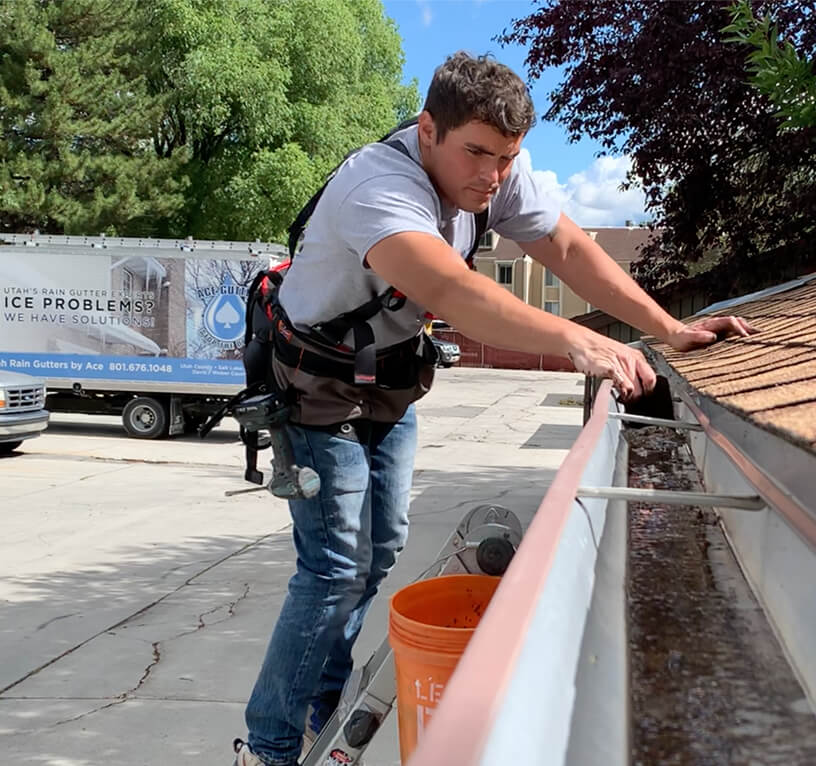
Safety first on the ladder. If the roof is steep or the gutters run two stories up, this is worth handing to someone who does it every day rather than risking a fall in October.
Prevention Checklist:
- Clear debris before the first freeze
- Flush each downspout and confirm it drains
- Tighten loose hangers and reseal gaps
- Extend discharge six feet from the foundation
When to Call for Service Instead
A homeowner with a ladder handles most of this. Some of it is not worth doing yourself, and knowing which is which saves money and reduces risk.
Where a professional earns the call:
- Two-story runs and steep roofs, where the fall risk outweighs the cost of the service
- Sagging or separated sections, which need rehanging rather than cleaning
- Chronic ice damming, where the fix is ice melt cable or an attic insulation problem rather than gutter work
- Undersized systems, since adding downspouts or moving to a larger profile is not a DIY repair
In many cases, an inspection finds something a homeowner would not. Hangers pulling out of soft fascia, a hidden leak at a seam, or a slope that drifted over the years all affect how the system functions under load.
Vital repairs cost less in October than in February. Crews have availability before the weather turns, and a gutter that works in November won’t leak into your soffit in March.
Did You Know: Most of the emergency calls we get in January trace back to debris left in the gutter in November. The cleaning is cheap, and the ice damage it prevents is not.
Prepare Your Gutter System
A very strong El Niño is on the way, and nobody knows exactly how an El Niño Utah winter will play out. What you control is whether your gutters are clear, draining, and discharging away from the house before the first freeze.
Since 1998, our team at Ace Gutter has helped Utah homeowners and business owners protect their properties through cleaning, repairs, and installations. We know how this climate moves water through the system season after season.
Request a quote today, and we will tell you what needs attention before the weather turns.
Frequently Asked Questions About Gutters and Utah Winter Weather
Will an El Niño Utah Winter Bring Heavy Snow?
Not necessarily. NOAA favors above-normal temperatures for Utah this winter, with northern Utah leaning drier and southern Utah wetter, so the bigger risk is rain on snow and repeated freeze-thaw rather than snow load.
When should I clean my gutters before winter?
Late October, once the leaves have finished dropping. Clearing earlier means doing it twice, and waiting until November risks finding debris already frozen in place.
Can ice damage my gutters permanently?
Yes. Ice weight pulls hangers out of the fascia, bends the trough, and separates seams, and a run that has iced up badly once usually needs rehanging rather than another cleaning.
Do gutter guards help in a Utah winter?
They reduce debris, which reduces ice. They do not stop ice dams, since those form from heat escaping the roof rather than from anything in the gutter itself.
How far should downspouts discharge from the house?
At least six feet, farther if the ground slopes back toward the foundation. Extensions and splash blocks cost very little compared with the water damage they prevent.

Need Help? Get a free assessment
Get a call back within 1 hour
(During business hours).
Recent Posts

Is Your Gutter System Ready for an El Niño Winter in Utah?

How Well-Maintained Gutters Can Increase Your Home’s Value

How to Improve Drainage and Water Flow in Aging Gutter Systems?

6 Factors That Can Shorten the Lifespan of Your Gutters

What to Know Before Installing Leaf Guards on Your Existing Gutter System?
Share
Recent Posts
Is Your Gutter System Ready for an El Niño Winter in Utah?
October 14, 2026
TL;DR: A very strong El Niño is forecast for the 2026-27 Utah winter, bringing warmer temperatures and more freeze-thaw cycles, not guaranteed snow....
How Well-Maintained Gutters Can Increase Your Home’s Value
October 13, 2026
TL;DR: Well-maintained gutters help preserve your home’s value by directing water away from the roof, siding, foundation, and landscaping. Regular cleaning, timely repairs,...
How to Improve Drainage and Water Flow in Aging Gutter Systems?
October 2, 2026
If you are seeing puddles around your foundation, streaks along the siding, or soggy spots in the yard, your gutters may be struggling...